
Safety Resources
Water and Wandering Safety
Water can be both fun and therapeutic, but for individuals with Autism Spectrum Disorder (ASD), it can also pose serious risks. Research shows that drowning is the leading cause of accidental death in children and young adults with autism, making proactive water education and training critical for families and caregivers.
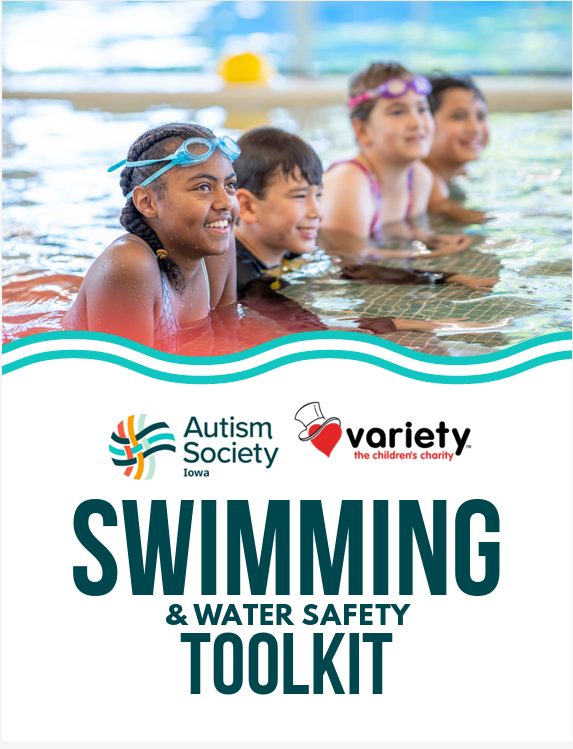
The Autism Society of Iowa has developed the Water Safety Toolkit to provide practical guidance, resources, and support for families looking to improve water safety for their loved ones with autism. The toolkit includes a listing of providers offering adaptive swim lessons, social stories, and visual supports that help teach water safety concepts.
Click Here to download the Autism Society of Iowa Swimming and Water Safety Toolkit.
Need help with the cost of swimming and water safety classes? Click Here to apply for the Autism Society of Iowa Water Safety Scholarship.

Big Red Safety Box
The National Autism Association is committed to those with an Autism Spectrum Disorder (ASD) who may be prone to wandering off or eloping from a safe environment, and may be unable to recognize danger and/or stay safe. Wandering, elopement, “running” or fleeing behaviors among those within our community not only present unique safety risks, but also create extraordinary worry and stress among caregivers.
The Big Red Safety Box is a free-of-charge toolkit given to autism families in need as a means to educate, raise awareness and share simple tools that may assist them in preventing, and responding to, wandering-related emergencies.
For more information, go to Big Red Safety Box.
Project Lifesaver
The task of searching for wandering or lost individuals with Alzheimer’s, Autism, Down syndrome, Dementia, or other cognitive conditions is a growing and serious responsibility. The primary mission of Project Lifesaver is to provide a timely response to save lives and reduce potential injury for adults and children who wander.
For more information about Project Lifesaver, Click Here to visit their website.
Autism and First Responder Training
Dennis Debbaudt is the leading global voice on autism training for law enforcement and emergency responders. Autism recognition, response and risk management training sessions will help law enforcement, fire-rescue and emergency medical response, and criminal/juvenile justice professionals recognize the behavioral symptoms and characteristics of a child or adult who has autism, learn basic response techniques, learn about the high risks associated with autism, and will offer suggestions, options and specialized tactics about how to address those risks, increase officer and citizen safety, and avoid litigation. The training can be tailored to meet the needs of local communities and agencies.
For more information on autism safety training in your community, visit: Autism Risk and Safety Management.
Driving
Many persons with ASD face challenges while driving. Whether you are considering driving or you have already obtained your license, you should be aware that the State of Iowa allows a Medical Alert designation on your license. It will appear in red bold letters on the bottom right corner. It is then up to the individual to decide how this information is shared. No additional forms need to be completed with the Iowa DOT. Some people choose to have an informational card and some just place a sticky note on the back of their license to let an officer know of their disability. Remember, you have the right to choose to disclose your disability.
Getting a Driver’s License in Iowa
- For more information about ASD and driving, Dennis Debbaudt an expert in Risk Management, has created a video with the assistance of Jerry Newport. For more information, click here: Autism & The Descision to Drive.
- The National Advanced Driving Simulator (NADS) is an independent, self-funded research unit at The University of Iowa. Their past research has studied persons on the spectrum, providing driving simulator instruction. To learn about upcoming volunteer opportunities or for more information, click here: National Advanced Driving Simulator.
- Drive Wise Academy specializes in tailored driving education for adults and adults with disabilities. Their mission is to empower every student with the skills and confidence needed to navigate the roads safely and independently, while preparing to take the IDOT road test to get their license. Using state-of-the-art adaptive vehicles equipped with the latest technology ensures a comfortable and effective learning experience.
- Safer Driver Solutions
- Safer Driver Solutions offers the best in specialized driving needs. For more information, click here.
- If utilizing Iowa Vocational Rehabilitation Services, click here for a printable flyer.
- For private pay, click here for printable flyer.
Funding Support for Anti-Elopement/Wandering Devices
November 10, 2016 – by Iowa Compass
Assistive technology (AT) can help stop elopement or the wandering away of people with autism spectrum disorder. AT can be as simple as building a fence. It can be as complex as using GPS tags to locate someone who wanders away and gets lost. AT devices may be expensive. But there is funding support for families and caregivers of people with autism.
Funding Sources
Common funding sources for AT devices include the following programs:
- The Iowa Medicaid Waiver Program has seven waivers in its home and community-based services (HCBS) waiver program.
- National groups include Autism Speaks and ACT Today.
- Local charities in Iowa include Children at Home, the Shayla Bee Fund and the Henry K. Peterson Foundation.
Online crowd-sourced funding—or crowdfunding—is also an option. It offers a new way to raise funds to support a cause or meet a need. This can include raising money to pay for AT devices. Crowdfunding requires access to the Internet, using a computer or smartphone. It relies on social media networking to share news about the fundraising.
Government Funding
The Edward Byrne Memorial Justice Assistance Grant Program provides funding for AT devices. Local police departments can apply for this funding for families and providers. Learn more about this program from Dennis Wiggins at the Iowa Department of Public Safety at dennis.wiggins@iowa.gov or 1-515-725-0311.
Added Support to Stop Elopement and Wandering
Support to stop elopement or wandering can include more than funding for AT devices. Families and caregivers of people on the autism spectrum with wandering issues should get in touch with their local police to learn about other support. This also lets the police know you might need their help if a loved one wanders away.
Contact Compass online at www.iowacompass.org or call 1-800-779-2001 for more information.